
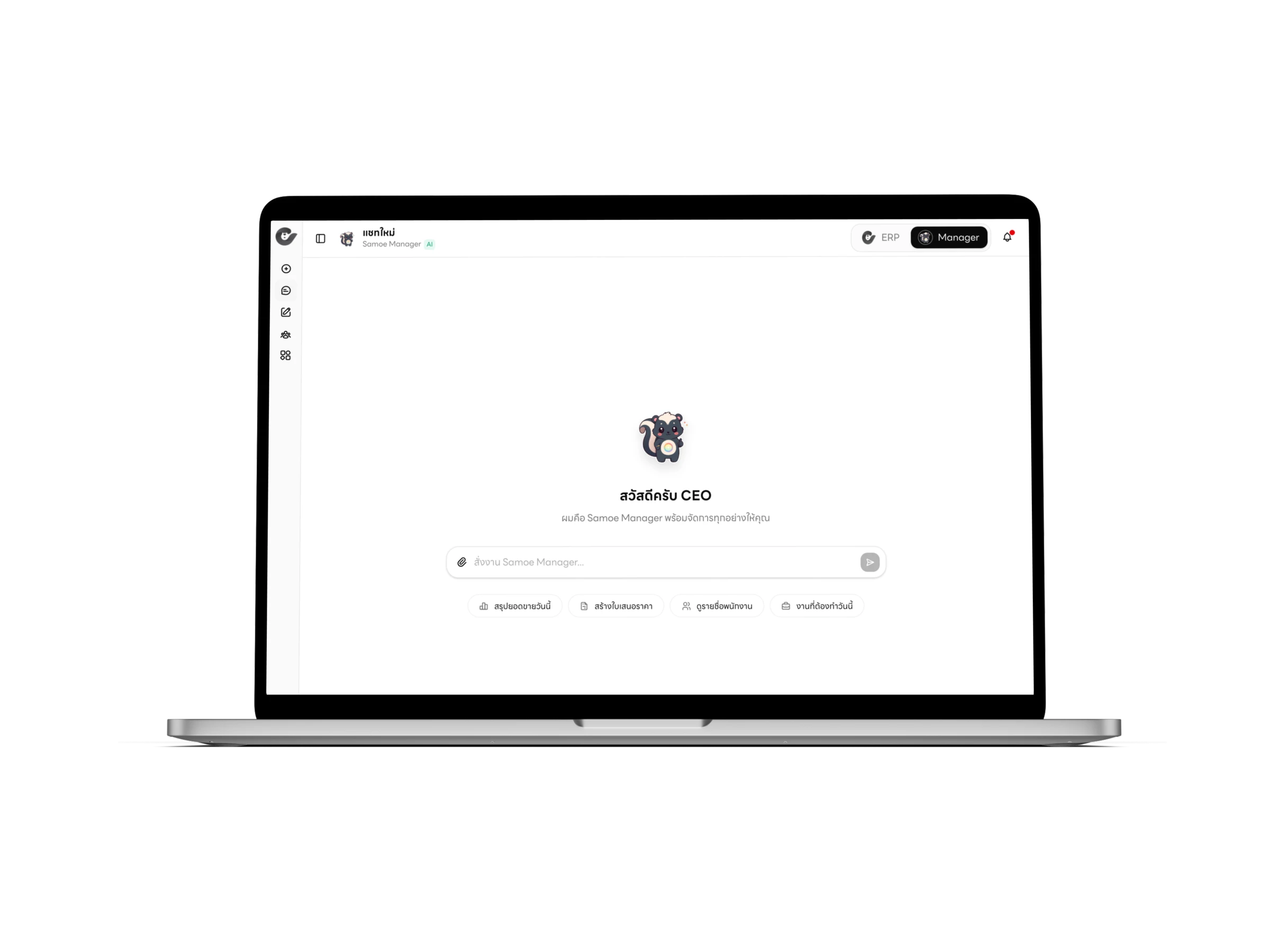
What is AI ERP
If traditional ERP is a digital filing cabinet that waits for staff to key data in and the owner to pull a report, AI ERP is the same cabinet with AI co-workers running 24/7, reading invoices, watching inventory, seeing cash flow, and then analyzing and recommending what the owner should do next.
Technically, AI ERP is an ERP system with multiple AI agents working together, an accounting agent reads invoices and categorizes them, an inventory agent flags low stock, a sales agent summarizes results and suggests follow-up customers, a finance agent answers the owner's questions in Thai. All agents run on your business's data, not a public chatbot trained on the internet.
AI ERP vs traditional ERP
Adding the word "AI" to a product page doesn't make it AI ERP. The dividing line is how much the system does without being asked, and whether it works on your data or just answers general questions.
Filing cabinet, waits for input
Co-worker, acts on your data
Staff types every line
AI agents read invoices/slips/photos and record them
Manager pulls reports
AI summarizes and pushes to the owner
Owner guesses from numbers
AI recommends actions with reasoning
Mostly desktop in the office
Mobile + chat + Thai voice
The most important difference is who works first. Traditional ERP waits for people to work before there is any data. AI ERP has AI staff working first, and the owner reviews and approves. This is why we call our approach Co-work Agent ERP, humans and AI working alongside each other, not AI replacing humans.
5 signals your SMB is ready for AI ERP
Not every business needs AI ERP today. But if you say "yes" to 3 or more of these 5, every month you delay is a visible cost.

Before AI ERP
Owner does everything manually, daily, endlessly
You still juggle multiple Excel files that don't talk to each other
Stock file, sales file, accounting file, separate places, reconciled at month-end. Every hour spent here is an hour not selling.
The owner still keys and reviews documents every day
Invoices, POs, receipts, transfer slips. If the owner spends > 2h/day on these, you're the accountant of your own company.
You see this month's profit later than 7 days after month-end
If your P&L lands in the second week of the following month, you're deciding with last month's data, not today's.
Multiple branches/channels but no single view
Storefront + Shopee + Line + TikTok, but no unified stock. You run out while the system says you have it.
You're hiring more because of paperwork, not because the business is growing
Every ฿25,000, ฿35,000/month for data-entry headcount is a signal your workflow needs AI agents, not more humans.
Who AI ERP is for (and who it's not for)
High-SKU shops, building materials, auto parts, grocery
Inventory agents flag low stock from real sale patterns, not static minimums.
Service / contracting businesses with many document types
Quote → delivery note → invoice, agents generate one from the next without re-keying.
Multi-branch or omnichannel retailers
Unified stock, unified reports, per-branch P&L from a single phone.
Owners who run the business from outside the office
Mobile AI ERP is for owners on job sites, in front of customers, not glued to a desk.
Family businesses going through generational transition
AI agents capture the parents' know-how into data so the next generation reads it forward instead of restarting.
Shops selling < 50 items/month
Any ERP subscription is hard to justify, a notebook + a monthly summary app is enough.
Businesses with no defined processes yet
AI ERP accelerates an existing process. If none exists, write your workflow first; software won't fix that.
Organizations that need 100% on-prem for specific compliance reasons
Most AI ERP is cloud-native. If you truly need air-gapped, it's a case-by-case conversation.
Must-have features for AI ERP in the Thai SMB market
Criteria for evaluating AI ERP in Thailand. Not every product imported from abroad serves Thai SMBs well.
- Department-level AI agents (accounting / inventory / sales / HR), not a single all-purpose chatbot
- OCR + Thai-language understanding for invoices, receipts, and transfer slips
- Full e-Tax Invoice + WHT support per Thai Revenue Department standard
- PromptPay QR embedded in quotes and invoices, no manual stitching
- True mobile experience, not just a responsive website. Owner orders, approves, signs, reviews P&L from phone
- Real Thai language in UI and AI agents, Thai voice input, easy-to-read responses
- Transparent monthly pricing, not just "contact for a quote"
- Free trial before contract, no multi-year lock-ins
- Data export and backups anytime, no vendor lock-in
- Open API/MCP to connect to LINE OA, Shopee, Lazada, Thai Revenue, and other tools you already use
AI ERP vs Agent Harness, the L0, L4 framework
"AI ERP" and "Agent Harness" are often used interchangeably, but they live at different layers of the same stack. UPLIFT uses an L0, L4 framework to keep the discussion honest.
| Level | Label | Description |
|---|---|---|
| L0 | NO AI | Excel, notebooks, legacy ERP with no AI |
| L1 | CHATBOT | Pattern-matching FAQ bots; no actions |
| L2 | AGENT | A single AI agent executing one task at a time |
| L3 | CO-WORK ⭐ | Multiple agents collaborating on business data alongside humans |
| L4 | ORGANIZATION | AI runs the whole organization, no one is here yet (5-year vision) |
Agent Harness is the infrastructure layer that lets multiple AI agents collaborate on a single dataset. AI ERP is the user-facing product. Said differently: Agent Harness is the engine; AI ERP is the car.
In this framework, Samoe ERP sits at L3 (CO-WORK), multi-agent, working alongside humans on the customer's business data. Not L1 chatbot, and not claiming L4 (because nobody is there yet).
How to start with AI ERP, a 3-step path
Write today's workflow first (1-2 weeks)
List the work you repeat daily/weekly, who takes the order, who keys, who approves, who ships, who invoices. Paper or Notion is fine. The point is to see the flow before shopping for tools.
Pick an AI ERP with a free trial that passes the 10-point checklist (2-4 weeks)
Pilot the most janitorial part first, invoicing + PromptPay, or scanning receipts. Don't change everything at once. The goal is to cut "owner data entry" by 50% in the first month.
Expand department by department, not big-bang (2-3 months)
Month 1: accounting + inventory. Month 2: sales + customer. Month 3: HR + payroll. This is safer than the big-bang migrations that fail mid-flight, because the business doesn't pause for the rollout.
Within 90 days, if you still manually key/check documents >1hr/day, the AI ERP you chose isn't truly L3.
AI ERP for Thai SMBs, short comparison
Short table, full 7-vendor comparison coming at [/en/ai-erp/compare] next week
| Dimension | Global ERP (SAP/NetSuite/Odoo) | Other Thai AI ERP | Samoe ERP |
|---|---|---|---|
| Positioning | Enterprise / on-prem / IT-heavy | Desktop accounting + AI bolt-on | Mobile-first, Co-work Agent ERP |
| Starting price | Tens of thousands, hundreds of thousands /mo | ฿790, ฿2,000/mo (accounting-focused) | ฿1,990/mo (all departments) |
| Thai / e-Tax / PromptPay | Partial | Full | Full |
| AI agents | L1, L2 (chatbot / single agent) | L1, L2 | L3 (multi-agent, co-work) |
| Mobile use | Partial | Partial | Full, owner runs the business from mobile |
Frequently Asked Questions

Try Samoe ERP, the Co-work Agent ERP for Thai SMBs
Free trial, no card required. ฿1,990/month after. Try every department agent, accounting, inventory, sales, HR, on mobile.
Read next
AI & ERP Articles

Stop Doing Repetitive Work by Hand: Process Automation and 7 Tasks You Can Start Today
Process Automation means letting your system handle repetitive document work instead of your team. Includes 7 real examples from Thai businesses, plus how to start one task at a time without tearing out your existing system.

Gemini 3.5 Flash Is Here: How Thai SMEs Can Use It
Google just released Gemini 3.5 Flash at Google I/O 2026, stronger than Gemini 3.1 Pro at coding and agentic work, with Computer Use support that lets the AI open a browser and work for you. Uplift helps install it into Thai SME businesses.
HyperFrames: Editing Video with AI Through HTML Instead of Dragging a Timeline in Premiere
HyperFrames is a framework that uses HTML + GSAP + data-* attributes as the 'source of truth' for a video, editable in a normal editor, rendered out to a deterministic MP4 every time, with AI able to help write it fully. It has audio-synced captions, TTS, audio-reactive effects, transitions, and background removal, all complete in a single tool.

Claude Skills: Turn Claude Into a Specialist for Your Work With a Single Folder
Skills is a new Claude feature that lets developers package a workflow, reference, and scripts into a bundle that Claude invokes on its own when needed, cutting context bloat, reusable across every project, and distributable as a plugin.

Using AI to answer customer chats 24/7: techniques any SME shop can start today
SME shops can answer customer chats all day without hiring staff, using a simple AI chatbot you can set up in 3 steps to save time and grow sales.

5 tasks AI can take over from an admin right away, no extra hire needed
Restaurants, shops, and service businesses can genuinely use AI for daily admin work: answering chats, scheduling, and checking stock, without relying on a programmer.
Why Thai SMEs Should Use an AI Workforce Instead of Hiring More Admin Staff
A real cost comparison: hiring an admin at 15,000 per month vs. an AI workforce that runs 24/7 with no days off, plus clear numbers worked out for restaurants and shops.

Use AI to Analyze Sales Across 3 Restaurant Branches in 5 Minutes
Multi-branch restaurant owners can analyze sales in 5 minutes with AI, without scanning Excel row by row. See which branch is losing money and which menu items sell best, and decide faster.